From “What’s An Exciton? (2019)” at hackaday.com:
- .. recently there has been a lot of buzz about excitons and even some transistor circuits demonstrated that use them. But what is an exciton?
- It actually sounds like a subatomic particle, but it is a little more complicated than that.
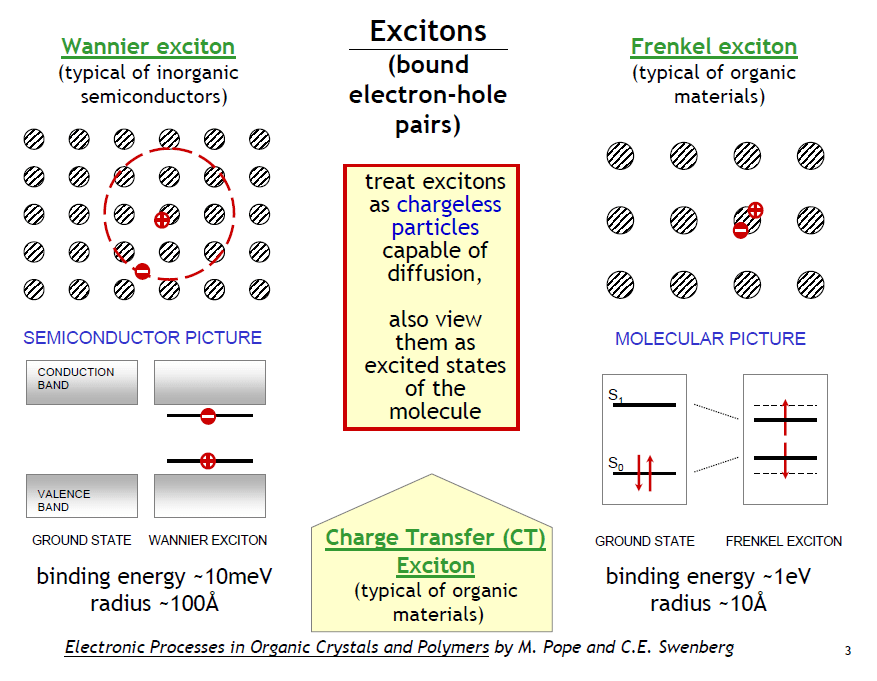
- An exciton is a bound state of an electron and an electron hole and is technically a boson.
- You are probably familiar with the idea of an electron hole from semiconductor physics. Technically, it is a quasiparticle.
- The reason scientists are interested in the beast is that it can transport energy without transporting net electric charge. That is, the state itself is neutral, but also contains energy.
- École Polytechnique Fédérale de Lausanne (EPFL) had the breakthrough last year that allowed room temperature exciton transistors. Link to EPFL paper “Room-temperature electrical control of exciton flux in a van der Waals heterostructure”.
- One way to form an exciton is to hit a material with a photon above its bandgap energy. This moves an electron from the valance band into the conduction band. The new spot on the conduction band is the electron and the hole back on the valence band is bound to the electron by electrostatic force. In particular, the hole’s attraction to all the surrounding electrons keeps everything stable. It also consumes a bit of the pair’s energy.
- In his 1931 paper, Yakov Frenkel, actually, was describing something observed by H. H. Poole involving conduction in insulators. In fact, Frenkel introduced the idea of a hole into the physics vernacular and certain types of holes are still known as Frenkel defects.
- What will this mean for us? Nothing this week. But someday in the future, the IC you are using might just take advantage of these exotic particles. While that might sound far-fetched, imagine how crazy it would have sounded to a tube radio designer in the 1930s that in just a few decades we’d have something that acted like a tube, would fit on your fingernail, and be totally rugged by comparison to a tube.
In 1931, Yakov Frenkel proposed “excitation waves” in his paper On the Transformation of light into Heat in Solids:
Starting from the analogy between a crystal and molecule, it is shown that the electronic excitation, forming the first step in the process of light absorption, is not confined to a particular atom, but is diluted between all of them in the form of “excitation waves,” similar to sound waves which are used to describe the heat motion in the same crystal.
W Y Liang in his article “Excitons (1970)” says:
An exciton is a quantum of electronic excitation energy travelling in the periodic structure of a crystal; it is electrically neutral and hence its movement through the crystal gives rise to the transportation of energy but not charge.
From the entry at britannica.com:
- Exciton, the combination of an electron and a positive hole (an empty electron state in a valence band), which is free to move through a nonmetallic crystal as a unit.
- Because the electron and the positive hole have equal but opposite electrical charges, the exciton as a whole has no net electrical charge (though it transports energy).
- This makes excitons difficult to detect, but detection is possible by indirect means.
- When an electron in an exciton recombines with a positive hole, the original atom is restored, and the exciton vanishes.
- The energy of the exciton may be converted into light when this happens, or it may be transferred to an electron of a neighbouring atom in the solid.
- If the energy is transferred to a neighbouring electron, a new exciton is produced as this electron is forced away from its atom.
From “Excitons in Crystals” at sciencedirect.com, quoting “B.P. Zakharchenya, S.A. Permogorov, in Encyclopedia of Condensed Matter Physics, 2005″:
- Excitons represent a wide class of intrinsic electronic excitations in crystals of semiconductors and dielectrics.
- A characteristic feature of excitons is that their formation (e.g., at optical excitation) does not lead to the separation of carriers, so that the excitons are electrically neutral excitations.
- Originally, the concept of excitons was introduced by Ya I Frenkel in 1931 to explain the light absorption in crystals which does not lead to photoconductivity.
- In the Frenkel model, the exciton is considered as an electronic excitation of one crystal site with the energy close to, but a bit smaller than that necessary for the excitation of a free electron.
- Due to the translation symmetry of the crystal, the exciton can move along the lattice sites transferring the energy to the electrically active or luminescence centers.
- So, the excitons play a significant role in most of the photoconductivity and light emission processes.
- The character of exciton motion depends on the strength of the exciton interaction with phonons.
From Lecture Notes “Lecture 7. Excitons – Types, Energy Transfer (PDF)” of MIT Course “Organic Optoelectronics”:
- In some applications it is useful to consider electronic excitation as if a quasi-principle, capable of migrating, were involved. This is termed as exciton.
- In organic materials two models are used: the band or wave model (low temperature, high crystalline order) and the hopping model (higher temperature, low crystalline order or amorphous state).
- Energy transfer in the hopping limit is identical with energy migration.
Related links:
 THE OMNIZIENT KNOWLEDGE ENGINE