Child Pages
KNOWLEDGE ENGINEERING
The dictionary defines engineering as:
The art or science of making practical application of the knowledge of pure sciences, as physics or chemistry, as in the construction of engines, bridges, buildings, mines, ships, and chemical plants.
The term Knowledge is defined by dictionary as:
Acquaintance with facts, truths, or principles, as from study or investigation; general erudition:
Hence, the art or science of making knowledge available as a practical application can be termed as Knowledge Engineering.
However, in contemporary thinking, knowledge is looked upon primarily as a field of artificial intelligence (AI) – simply defined here as a field “that creates rules to apply to data in order to imitate the thought process of a human expert”.
We may expect to find a lot of Knowledge Engineering tools and techniques that are useful in our goal to access diverse kinds of knowledge.
Further Reading:
KNOWLEDGE ENGINES
Knowledge Engine is not a standard term yet. The wikipedia leads to multiple entries:
- Weaviate, an open source knowledge graph developed by SeMI Technologies
- Wolfram Alpha, a computational knowledge engine or answer engine developed by Wolfram Research
- Knowledge Engine (Wikimedia Foundation), a search engine project by the Wikimedia Foundation
- Knowledge graph, the concept in information science
- Knowledge Graph, a knowledge base used by Google to enhance its search engine’s search results with semantic search information gathered from a wide variety of sources
Researchgate.net throws up a paper “Instantly Deployable Expert Knowledge – Networks of Knowledge Engines” by multiple authors. The paper’s vision states:
We envision a new culture and technology framework to enable scalable knowledge
utilisation for solving human problems beyond those restrictions. In its limit, the envisioned framework enables everyone to utilise humanity’s total knowledge in full depth for each individual challenge. While it is of course utopian to expect the full realisation of this vision any time soon, it can provide the course for a self-determined humankind in the beginning age of artificial intelligence.
Marco Barnig shares about eyePlorer – a graphical knowledge engine created by vionto® (now shut down) in his article eyePlorer : the knowledge machine:
Current search engines only present lists of links and documents, with eyePlorer however, you are able to locate relevant information and connections instantly. Facts and relationships between terms and concepts are visualised in an interactive application. The knowledge machines build by vionto® employ sophisticated semantic techniques in order to analyse the meaning of sentences and texts. The benefit for the user is that he or she can work with individual facts instead of just long documents.
The engine is still active at eyeplorer.com. The search for term “Knowledge” leads to the following view (each term clickable):
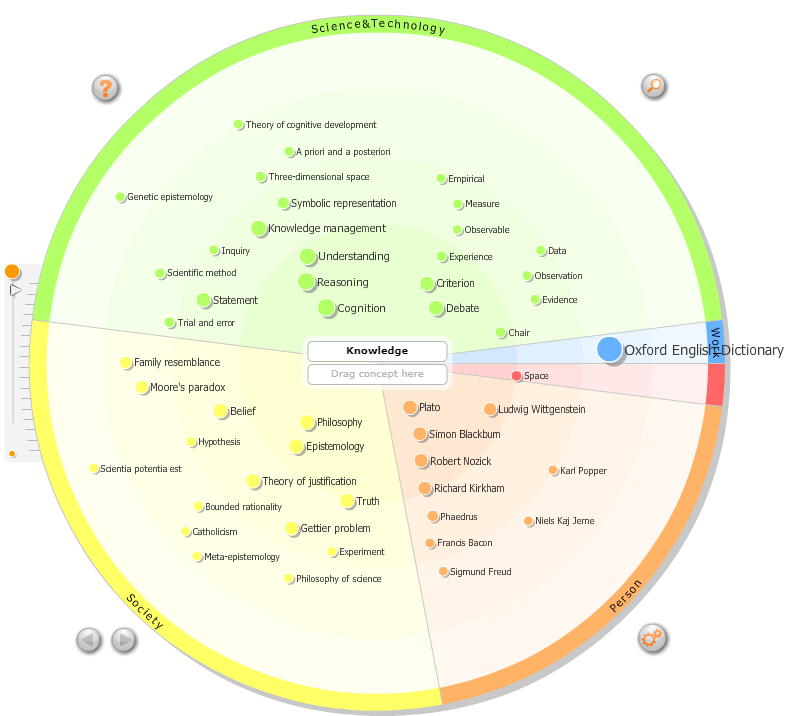
Marco Barnig further shares:
The user does not work with documents but with knowledge and facts in a graphical, interactive, almost dialogue-like kind of way. Knowledge is visually arranged in different categories. vionto® knowledge machines are based on semantic analyses derived from cognitive science, brain research and computational linguistics. vionto® relies on a robust language technology platform and sophisticated linguistic resources such as, for example, ontologies and thesauri.
It is interesting to have a look at this seemingly rudimentary “knowledge engine”.
Of course, one of the most famous computation knowledge engine is “Wolfram|Alpha”. Here is a fun post by founder Stephen Wolfram “Did Stephen Wolfram’s Knowledge Engine Just Become a Quantum Neural Blockchain AI?” where he concludes:
Yup, according to physics, we know we are “quantum”. Neural nets capture many core features of how our brains seem to work. Blockchain—at least as a general concept—is somehow related to individual and societal memory. And AI, well, AI in effect tries to capture what’s aligned with human goals and intelligence in the computational universe—which is also what we’re doing.
OK, so what’s the closest thing we know to a QNBAI? Well, it’s probably all of us!

 THE OMNIZIENT KNOWLEDGE ENGINE